

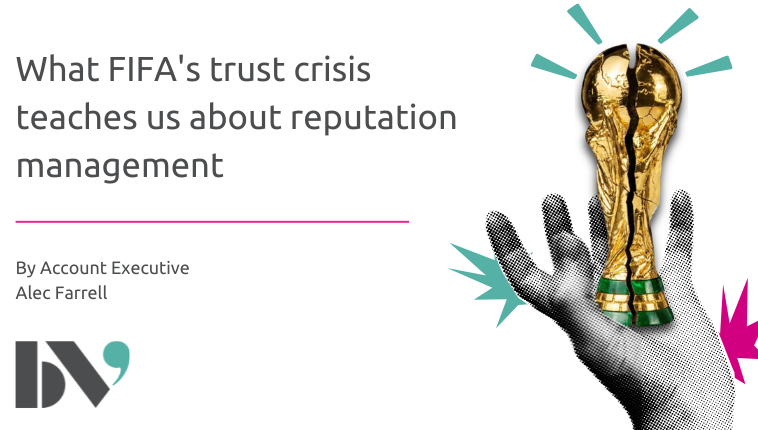
What FIFA’s trust crisis teaches us about reputation management
The trust of its audience is the one asset that no organisation can buy, and FIFA (Fédération Internationale de Football Association) seems to be going through a public lesson in this school of thought at the moment.
The controversy began when The Times uncovered Gianni Infantino’s (FIFA’s president) plans to create a new company to manage the commercial and ticketing rights of all FIFA competitions, including the World Cup. The proposal was titled the ‘FIFA Forward Enterprise (FFE)’, which would have seen a 21% stake sold to a private investment firm.
Following this news, three of football’s most powerful governing bodies (UEFA, CONCACAF and the Asian Football Confederation) issued an open letter accusing their own president, Gianni Infantino, of breaking trust “through deception.”
For a PR agency like us, moments like this are more than tabloid football news stories. They’re a case study in exactly how reputations are built, tested and lost, and a lesson that any organisation can learn from.
Very rarely do you see senior figures within an organisation publicly turn on its leadership, in writing, for the world to see.
So, what happened?
The uncovered proposals claim that football does not raise enough revenue in relation to its fan base and suggested that there was potential for $1,000+ tickets, dynamic pricing and the opportunity to put broadcasting of the world’s biggest sports tournament behind a paywall.
To put that into perspective, the World Cup is widely considered the most-watched sporting event in the world with fans going into the billions and is often referenced as ‘the world’s game.’
Part-privatising the World Cup would have meant that FFE would become the lead organiser and operator of the tournament, making it responsible for ticketing, broadcasting, licensing and sponsorship.
The increase in funding would naturally trickle down to individual organisations and their grassroots developments. However, whilst FIFA maintained that the standard development funding increase of $8 million to $20 million per member association would be paid regardless of how an association voted, it also stated that there would be a separate one-off $20 million payment per association if they agreed to support the proposal. Associations in Africa were reportedly offered up to $40 million in exchange for backing the plan.
The lack of trust was not solely around the proposal as it’s whole, but also how it was communicated.
What followed wasn’t a quiet resolution.
The plan was scrapped after strong pushback from several confederations. Presidents and general secretaries of three major confederations wrote an open letter accusing FIFA’s leadership of a fundamental breach of trust and called for a fully independent review, rejecting FIFA’s own internal investigation as insufficient.
What are the lessons in trust and reputation?
- Exclusion breeds suspicion
The initial meetings FIFA held regarding the proposal were with hand-picked staff rather than elected representatives. This angered the confederations, who felt shut out of the decision-making process.
When stakeholders, employees or partners feel sidelined from decisions that affect them, they don’t stay quiet. They eventually go public, and by then, the story is no longer about the original issue. It’s about being kept in the dark, a pattern that can often show up in corporate crises.
- A partial apology can be worse than no apology
FIFA did acknowledge that mistakes had been made in how the proposal was handled, but the confederations still felt like this fell short of what was needed.
Whilst FIFA apologised for how the proposal was handled, who was consulted and the way it was communicated, the organisation never took ownership of it being a bad idea in the first place – reflection is key for an audience to see true ownership.
An apology that addresses the process but not the decision itself is one of the most common traps in crisis communications and often reads as more evasive than saying nothing at all.
- Internal reviews rarely rebuild trust
When FIFA proposed handling its own review internally, the confederations rejected it outright, insisting on a fully independent third party instead. Once trust has been broken, marking your own homework doesn’t restore it. Independent scrutiny does the work that internal reassurance can’t.
The bigger picture
What makes this story so relevant from a reputational standpoint is not the politics but the speed of the collapse and the inadequate attempt to make up for it afterwards.
Infantino’s leadership had been under scrutiny for a while, but the FFE proposal was the moment that discontent turned into open confrontation. Once key stakeholders felt they’d been deceived rather than consulted, the position he held for ten years came under serious public threat within a matter of weeks.
That’s the nature of trust. It accumulates slowly, through consistent and transparent behaviour, but can evaporate overnight the moment people feel misled. Organisations that treat trust as something to manage only when a crisis hits are usually the ones that get caught out.
Building trust before you need it
Whether you’re a global sporting body or a local Guernsey business, the principle is the same. Reputation isn’t built in the moment of crisis; it’s built in the years of communication, transparency and stakeholder engagement that come before it.
At Black Vanilla, this is exactly the kind of work we specialise in. Proactive reputation management and crisis communications planning, so that when pressure lands, you’re not scrambling to explain yourself.